Penetration Testing vs. Vulnerability Assessment: Which Do You Need?
Vulnerability assessments find known issues. Penetration tests prove what an attacker can actually do. Here's how to decide which one your organization needs.
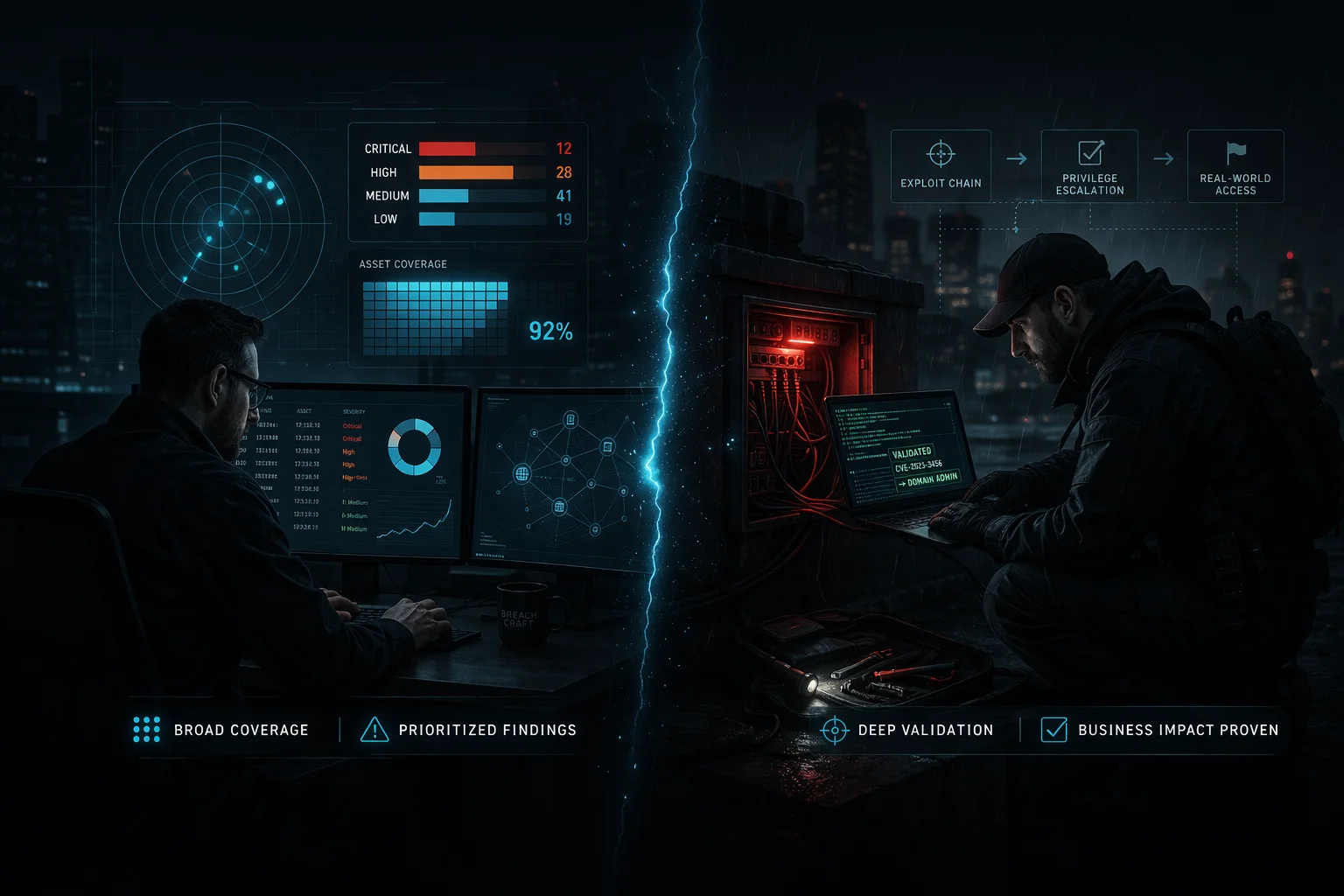
The terms get used interchangeably, and that causes real problems. We’ve seen organizations buy a vulnerability scan thinking they were getting a penetration test, then fail a compliance audit because the deliverable didn’t meet the requirement. We’ve also seen companies pay for a full penetration test when a vulnerability assessment would have answered their actual question.
They’re different services. They answer different questions. And knowing which one you need saves you money and gets you the right outcome.
The Short Version
A vulnerability assessment answers: “What known weaknesses exist in our environment?”
A penetration test answers: “What can an attacker actually do to us?”
The first is broad and automated. The second is deep and human-driven. Most organizations need both, but not at the same time and not for the same reasons.
Side-by-Side Comparison
| Vulnerability Assessment | Penetration Test | |
|---|---|---|
| Approach | Automated scanning with manual validation | Manual testing with creative exploitation |
| Depth | Broad coverage, identifies known issues | Deep, proves exploitability and business impact |
| Frequency | Monthly or quarterly | Annually or after major changes |
| Duration | 1-3 days for most environments | 7-30 business days depending on scope |
| Cost | $2,000-$10,000 | $5,000-$100,000+ |
| Output | Prioritized list of vulnerabilities | Attack narrative with exploitation evidence |
| Automation | Primarily automated, manually validated | Primarily manual, tools assist |
| Finds | Missing patches, misconfigurations, known CVEs | Business logic flaws, chained attacks, real-world paths |
| Best for | Ongoing hygiene, baseline visibility | Proving risk, compliance requirements, security validation |
When a Vulnerability Assessment Is the Right Call
A vulnerability assessment makes sense when you need breadth over depth. You want to know what’s exposed across your environment without necessarily proving every finding is exploitable.
- Building a security program from scratch. If you don’t have a clear picture of your environment’s security posture, start here. A vulnerability assessment gives you a prioritized list of issues to address before investing in deeper testing.
- Ongoing visibility. Vulnerabilities appear constantly. New CVEs, configuration drift, infrastructure changes. Regular scanning catches these as they appear rather than waiting for an annual test to find them.
- Compliance requires periodic scanning. PCI-DSS requires quarterly vulnerability scans by an Approved Scanning Vendor (ASV) in addition to annual penetration testing. HIPAA expects regular technical evaluations. Scans satisfy these requirements efficiently.
- Filling the gaps between penetration tests. An annual pentest is a point-in-time snapshot. Vulnerability assessments between tests catch what changes after the testers leave.
When to Bring in an Outside Firm for a VA
For basic network scanning, many organizations can run their own tools (Nessus, Qualys, Rapid7). But there are situations where outside expertise makes a real difference.
- You don’t have the staff to maintain it. Running scans is easy. Triaging results, filtering false positives, tracking remediation, and tuning scan policies takes ongoing cycles. If your team is stretched, a partner can handle the operational load and deliver clean, actionable results instead of raw scanner output.
- Your environment goes beyond simple network infrastructure. Cloud configuration reviews require deep knowledge of AWS, Azure, or GCP security models. SaaS security reviews evaluate M365, Google Workspace, and other platform configurations that network scanners don’t touch. Database security assessments look at access controls, encryption, and hardening across your data tier. These are specialized domains where generic scanning falls short.
- You need results mapped to a compliance framework. Raw scanner output doesn’t map to CIS Top 18 or NIST 800-53 controls on its own. An experienced firm delivers findings that your compliance team and auditors can work with directly.
When a Penetration Test Is the Right Call
A penetration test makes sense when you need proof. Not just a list of what might be wrong, but evidence of what an attacker can actually achieve in your environment.
- Your compliance framework specifically requires it. PCI-DSS requires annual penetration testing. CMMC Level 2 requires it. SOC 2 auditors expect it. GLBA’s Safeguards Rule now mandates it. If your framework says “penetration test,” a vulnerability scan won’t satisfy the requirement.
- You need to understand actual business impact. A scanner might flag 200 findings. A penetration test tells you which of those findings, combined in sequence, let an attacker reach your customer database, your financial systems, or your domain admin credentials. That context drives better prioritization.
- You’re evaluating whether your security investments are working. You’ve deployed EDR, segmented your network, and trained your staff. A penetration test validates whether those controls actually stop an attacker or just slow one down.
- You’ve had a breach or a near miss. After an incident, a penetration test helps verify that your remediation actually closed the gaps. It also builds confidence with leadership, customers, and insurers that you’ve addressed the root cause.
- You want to test the human element. Social engineering assessments (phishing, vishing, pretexting) test whether your people can recognize and respond to attacks. Scanners don’t test humans.
When You Need Both (and in What Order)
For most mid-size organizations, the answer is both. The question is sequencing and frequency.
- Never had either: Start with a vulnerability assessment. Get the baseline, fix the critical issues, then schedule a penetration test. Running a pentest against an environment full of unpatched systems wastes the tester’s time on findings a scanner would have caught in minutes.
- Building an annual program: Schedule your penetration test once a year (or after major changes). Run vulnerability scans monthly or quarterly in between. The scans catch drift and new exposures. The pentest validates your overall security posture with human judgment.
- Budget is tight: Phase it. Run a vulnerability assessment in Q1, address the findings in Q2, then schedule a penetration test in Q3. You get both services across the year instead of choosing one.
What Compliance Frameworks Actually Require
This is where the terminology confusion causes the most damage. Some frameworks are specific about what they require. Others are vague.
| Framework | Penetration Test Required? | Vulnerability Scanning Required? | Notes |
|---|---|---|---|
| PCI-DSS | Yes (annual) | Yes (quarterly ASV scan) | Both explicitly required |
| HIPAA | Implied (“technical evaluation”) | Implied (“technical evaluation”) | Not prescriptive, but auditors expect both |
| SOC 2 | Expected by most auditors | Expected | Not mandated in TSC, but standard practice |
| CMMC 2.0 Level 2 | Yes | Yes | Maps to NIST 800-171 requirements |
| GLBA Safeguards Rule | Yes (since 2023 update) | Yes | Specific requirement added in revised rule |
| NIST CSF | Recommended | Recommended | Framework, not regulation, but widely referenced |
| FERPA | Not specified | Not specified | DoE guidance increasingly references security testing |
If you’re unsure what your auditor will accept, ask them before you scope the engagement. “We did a vulnerability scan” when they expected a penetration test is a conversation nobody wants to have.
Choosing the Right Partner
Whether you need a vulnerability assessment, a penetration test, or both, the same evaluation criteria apply. Look for a firm that:
- Follows established methodologies (PTES, OSSTMM, OWASP Testing Guide)
- Maps findings to the frameworks your auditors care about
- Delivers reports your team can actually act on
- Doesn’t disappear after handing you a PDF
We offer both services and we’re straightforward about which one you actually need. If a vulnerability assessment answers your question, we’ll tell you that instead of selling you a penetration test.
Request a free consultation and we’ll help you figure out which assessment makes sense for your organization, your compliance requirements, and your budget.